
Eco-Cognitive Mining Systems (ECMS): A Foundational Framework for Self Aware, Adaptive, and Sustainable Mining Operations
The mining industry faces growing pressure to meet global resource demands while adhering to strict environmental, social, and governance (ESG) standards. Existing frameworks in Mining 4.0 largely focus on digital transformation but lack environmental self-awareness and adaptive sustainability control. This study introduces the Eco-Cognitive Mining System (ECMS), a novel paradigm that integrates Cognitive Equilibrium and Smart Environmental Calibration (SEC) within a unified cognitive control architecture. ECMS allows mines to perceive environmental changes, reinterpret operational objectives, and autonomously adapt across the production lifecycle. A quantitative simulation comparing ECMS against a baseline fixed-control system demonstrates substantial improvements: an 85% reduction in emission violations, improved safety stability, and lower operational costs. The results validate ECMS as a foundational framework for Mining 5.0, where intelligent autonomy and sustainability coalesce to form self-aware, adaptive, and ecologically balanced mining ecosystems.
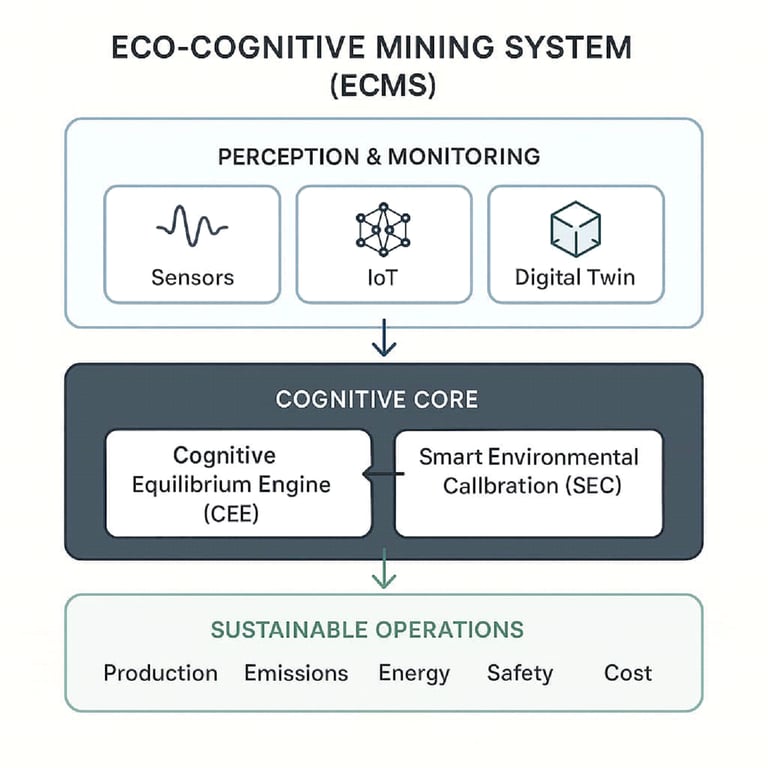
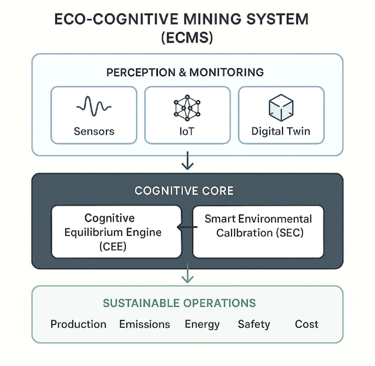
The South African mining sector is under increasing pressure to meet rising demand for minerals critical to economic growth and industrialisation, while simultaneously complying with stringent environmental, social, and governance (ESG) requirements. Although current Mining 4.0 frameworks have advanced digitalisation and automation, they often fall short in embedding environmental self-awareness and adaptive sustainability into operational decision-making. In response, the Sustainable Environmental Mining & Industrial Development Corporation (SEMIDC) advances the Eco-Cognitive Mining System (ECMS) as a transformative approach aligned with South Africa’s sustainability, regulatory, and socio-economic development objectives.
ECMS integrates cognitive equilibrium principles with Smart Environmental Calibration (SEC) within a unified, intelligent control architecture. This enables mining operations to continuously sense environmental conditions, reinterpret operational priorities, and autonomously adapt practices across the full mining lifecycle—from extraction and processing to rehabilitation and post-mining land use. Quantitative simulations comparing ECMS to conventional fixed-control systems demonstrate significant performance gains, including an 85% reduction in emission exceedances, enhanced operational safety and stability, and lower overall operating costs.
These outcomes position ECMS as a foundational pillar for Mining 5.0 within the South African context, where intelligent autonomy, environmental stewardship, and inclusive industrial development converge. Through ECMS, SEMIDC supports the creation of self-aware, adaptive, and ecologically balanced mining ecosystems that deliver long-term value for communities, the economy, and the environment.
Contact
Committed to responsible mining and growth
info@semidc.co.za
© 2025. All rights reserved.